
The EU AI Act became applicable in general on 2 August 2026, and its transparency rules for chatbots, deepfakes and AI-generated content now bind companies. Six days earlier, on 27 July, the AI Omnibus entered into force and moved the rules for high-risk AI to December 2027 and August 2028.
This is a plain timeline for a founder or marketing lead who uses AI tools and is not a lawyer. It describes the law and the European Commission's published guidance as of 4 August 2026. It is not legal advice.
The short version
- 01Since 2 August 2026 the transparency rules in Article 50 apply. People must be told when they talk to an AI system, and deepfakes and some AI-generated text must be labelled.
- 02The AI Omnibus, Regulation (EU) 2026/1744, did not delay Article 50. It gave Article 50 one grace period: generative systems already on the market before 2 August 2026 have until 2 December 2026 to mark their output.
- 03The high-risk rules moved to 2 December 2027 for the uses in Annex III, such as recruitment and credit scoring, and to 2 August 2028 for AI built into regulated products.
- 04If you only use AI tools, you are a deployer. Your duties today are labelling where Article 50 asks for it, supporting your staff's AI literacy, and avoiding the banned practices.
- 05If you build an AI system and offer it under your own name, you are its provider, and the duty to disclose and to mark output sits with you.
- 06National market surveillance authorities enforce the transparency rules in most cases. Fines reach EUR 15 million or 3% of worldwide annual turnover, whichever is higher; for SMEs and small mid-caps, whichever is lower.
What applies from 2 August 2026
The AI Act set 2 August 2026 as its general date of application, so every rule without another date applies from that day. For a company that uses or offers AI tools, that means above all the transparency rules in Article 50 and the fines behind them.
The Act entered into force on 1 August 2024 and applies in stages. The bans on prohibited practices and the AI literacy duty came first, on 2 February 2025. The rules for general-purpose AI models, the governance chapter and the penalties chapter followed on 2 August 2025.
On 2 August 2026 two things changed that a business will notice:
- Article 50 started to apply to AI systems that talk to people, to systems that generate images, audio, video or text, and to those who publish deepfakes or certain AI text.
- Enforcement powers over model providers started. The Commission's AI Act page says that from 2 August 2026 the AI Office and national authorities are responsible for enforcing the Act, and that the AI Office can request technical documentation from providers of general-purpose AI models, evaluate the models, require corrective measures and fine them. The original Article 113 held back those fines until this date.
The high-risk rules for the uses in Annex III were due on the same day under the original text. That is the part the Omnibus moved.
The Commission published guidelines on Article 50 on 20 July 2026. (Update, November 2026: the official version of the guidelines was published in the Official Journal on 12 November 2026 as C/2026/6005.) A voluntary Code of Practice on transparency of AI-generated content was finalised on 10 June 2026, and the Commission and the AI Board assessed it as adequate. The Commission's page on the code says about 190 organisations had signed it by the end of July 2026.
What the AI Omnibus postponed: the new deadlines
The Omnibus gave the high-risk rules 16 more months for the uses in Annex III and 12 more months for AI in regulated products. It left Article 50 on its original date, apart from a four month grace period for marking.
The Commission proposed it on 19 November 2025, a political agreement followed on 7 May 2026, and it was published in the Official Journal on 24 July 2026. Its recitals give the reason: standards for high-risk AI came late, and so did national authorities and conformity assessment frameworks, which made compliance heavier than expected.
Counted from the Act's entry into force on 1 August 2024, the rules for Annex III uses were due after 24 months and now apply after 40. The rules for AI in products moved from 36 to 48 months. Article 50 stays at 24 months, and the marking duty for generative systems already on the market moves to 28.
- High-risk uses in Annex III
- AI Act as adopted in 2024: 24 months After the AI Omnibus: 40 months
- High-risk AI in products, Annex I
- AI Act as adopted in 2024: 36 months After the AI Omnibus: 48 months
- Article 50 transparency
- AI Act as adopted in 2024: 24 months After the AI Omnibus: 24 months
- Marking for generative systems already on the market
- AI Act as adopted in 2024: 24 months After the AI Omnibus: 28 months
AI Act Articles 111 and 113, as amended by Regulation (EU) 2026/1744
The Omnibus also changed four things a business should know:
- A new ban from 2 December 2026. It covers AI systems that generate or manipulate realistic images, video or audio of an identifiable person's intimate parts or sexual activity without that person's explicit consent, and systems that generate child sexual abuse material. The Commission calls these nudification apps.
- A softer AI literacy duty. Article 4 now asks providers and deployers to take measures to support their staff's AI literacy, and says it "does not require providers or deployers to guarantee any specific level of AI literacy".
- Relief for small mid-caps. Under the Commission's 2025 definition, a small mid-cap is a company that is not an SME, employs fewer than 750 people and has a turnover of no more than EUR 150 million or a balance sheet of no more than EUR 129 million. Some SME reliefs now cover them, including simplified technical documentation and lower fine caps.
- A bigger AI Office. With some exceptions, it becomes the only supervisor for AI systems built on a general-purpose model by the same provider, and for AI in very large online platforms and search engines.
It also moved the deadline for national AI regulatory sandboxes from 2 August 2026 to 2 August 2027 and added an EU-level sandbox. And it took AI in machinery out of the Act's direct high-risk rules: those requirements are to be built into the EU Machinery Regulation instead. In the Regulation's text, the Machinery Regulation moves from Section A to Section B of Annex I, and the Commission must add the AI requirements to it by delegated acts that apply by 2 August 2028. The Commission's news item of 27 July and its page on the high-risk guidelines put it differently: both list machinery among the products whose AI rules apply from 2 August 2028, and neither mentions the move to the Machinery Regulation.
AI Act timeline: the key dates in one table
These are the dates a company that uses or builds AI should have in its calendar, as the law stood on 4 August 2026.
| Date | What applies | Who it concerns | Changed by the Omnibus |
|---|---|---|---|
| 2 February 2025 | Banned practices (Article 5) and AI literacy (Article 4) | Everyone who provides or uses AI | AI literacy duty softened |
| 2 August 2025 | Rules for general-purpose AI models, governance, penalties | Model providers, authorities | No |
| 27 July 2026 | AI Omnibus in force | Everyone | It is the change |
| 2 August 2026 | Article 50 transparency, general application, Commission fines for model providers | Providers and deployers | No, apart from the marking grace period |
| 2 December 2026 | Marking duty for generative systems on the market before 2 August 2026; ban on nudification apps | Providers of generative AI; anyone offering or using such apps | New dates |
| 2 August 2027 | General-purpose models on the market before 2 August 2025 must comply; national sandboxes running | Model providers, member states | Sandbox date moved from 2026 |
| 2 December 2027 | High-risk rules for Annex III uses, such as recruitment, worker management, education and credit scoring | Providers and deployers of those systems | Moved from 2 August 2026 |
| 2 August 2028 | High-risk rules for AI in products under Annex I, such as toys and lifts | Product makers and their AI suppliers | Moved from 2 August 2027 |
Deployer or provider: find your AI Act role first
Your duties depend on your role for each AI system. If you use a system under your authority for work, you are its deployer. If you develop a system, or have it developed, and put it on the market or into service under your own name, you are its provider.
Those are the definitions in Article 3 of the Act. The Commission's FAQ on Article 50 adds that employees acting on the company's instructions are not separate deployers, and that the company stays the deployer when contractors operate the system for it. A marketing team that drafts posts with a chatbot, makes images with a generator or runs the AI features of an ad platform is a deployer of those tools.
The grey zone is a company that builds its own chatbot on a model API and runs it on its website under its own brand. Article 3 counts supplying a system for your own use as putting it into service. In our reading that can make the company the provider of that chatbot under Article 50, while the model maker stays the provider of the model. Ask your lawyer to confirm this for your setup.
| Duty | Who carries it | Article | Applies from |
|---|---|---|---|
| Tell people they are interacting with an AI system | Provider | 50(1) | 2 August 2026 |
| Mark generative output in a machine-readable way and make it detectable | Provider | 50(2) | 2 August 2026; 2 December 2026 for systems already on the market |
| Inform people exposed to emotion recognition or biometric categorisation | Deployer | 50(3) | 2 August 2026 |
| Label deepfakes, and AI text on matters of public interest published without human review | Deployer | 50(4) | 2 August 2026 |
| Take measures to support staff AI literacy | Both | 4 | 2 February 2025, softened from 27 July 2026 |
| High-risk duties for Annex III systems | Provider (Article 16) and deployer (Article 26) | Chapter III | 2 December 2027 |
What applies if you only use AI tools
As a deployer you have three sets of duties today: the Article 50 labels where they apply, AI literacy, and the bans. The high-risk duties wait until 2 December 2027 at the earliest, and they reach you only if you use a high-risk system, such as one listed in Annex III.
The bans have applied since 2 February 2025. One is close to marketing: Article 5 bans AI that uses subliminal, purposefully manipulative or deceptive techniques to distort a person's behaviour in a way that causes or is reasonably likely to cause significant harm. From 2 December 2026 the nudification ban also covers using such a system to produce that material.
The AI literacy duty now asks for measures and sets no required level. The law does not say what form they take. We would keep a short written record: which tools staff use, what training they had, and who answers questions.
Annex III is where marketing and HR teams could be surprised. Point 4 lists AI used for recruitment, including systems that place targeted job advertisements, filter applications and evaluate candidates. Point 5 lists systems that assess people's creditworthiness.
From 2 December 2027, under Article 26, a deployer of such a system must use it as the provider instructs, give human oversight to competent people, monitor it, keep its logs for at least six months where it controls them, and tell workers and the people affected that the system is used. Public bodies, private companies providing public services, and deployers of credit scoring or life and health insurance pricing systems must also assess the impact on fundamental rights first, under Article 27. (Update, November 2026: on 16 November 2026 the Commission published a draft template for this assessment, which deployers will have to use once it is final; feedback is open until 15 January 2027. Deployers who will have to run the assessment can apply to test the template by 4 December 2026.) And Article 25 turns a deployer into a provider if it puts its own name on a high-risk system or makes a substantial change to it.
What applies if you build AI into a product
As a provider you carry the duties that are built into the system: telling people they talk to AI, and marking generated output. For a system launched on or after 2 August 2026 both apply now. A generative system already on the market before that date has until 2 December 2026, for the marking duty only.
The FAQ says the chatbot rule applies when a system is designed for a real two-way exchange and talks to people directly, with no human in between. People must be told from the first interaction, unless an average, reasonably well-informed person would find it obvious. The Commission says that exception is read narrowly.
Marking means two things together: a machine-readable mark in the output, and a way to detect it. The FAQ puts source code, short strings of characters, output that only passes between machines, and AI that only does standard editing outside the duty. It adds a narrow exemption for some business-to-business and industrial outputs. Providers who sign the Code of Practice can rely on it to show compliance. Those who do not must show other adequate means and, the FAQ says, may face more requests for information.
If you sell an image or video generator, check it against the new ban before 2 December 2026. A system is caught if producing that material is its purpose, or if the material is a foreseeable and repeatable result and the system lacks reasonable safeguards against it.
High-risk providers have until 2 December 2027 for Annex III uses and 2 August 2028 for AI in regulated products. Apart from systems used by public authorities, a high-risk system already on the market before those dates comes under the rules only if its design changes significantly afterwards.
Article 50 labelling rules in short
Deepfakes need a label people can see or hear at first exposure, AI text on matters of public interest needs a label unless a person reviewed it, and chatbots must say they are AI.
- A deepfake (the Act writes "deep fake") is, in the Act's definition, AI-generated or manipulated image, audio or video that resembles real people, objects, places or events and would falsely appear authentic. The deployer must disclose it at first exposure at the latest, in a way people can perceive without special tools. The provider's machine-readable mark alone does not meet this duty.
- For evidently artistic, satirical or fictional work, the disclosure can be limited so that it does not spoil the work.
- The text rule covers text published to inform the public on matters of public interest, such as politics, public health, consumer safety or economic and financial developments. It does not apply if a person with relevant knowledge reviewed the substance and someone holds editorial responsibility. A spell check is not a review.
- Content generated before 2 August 2026 does not need a label after the fact.
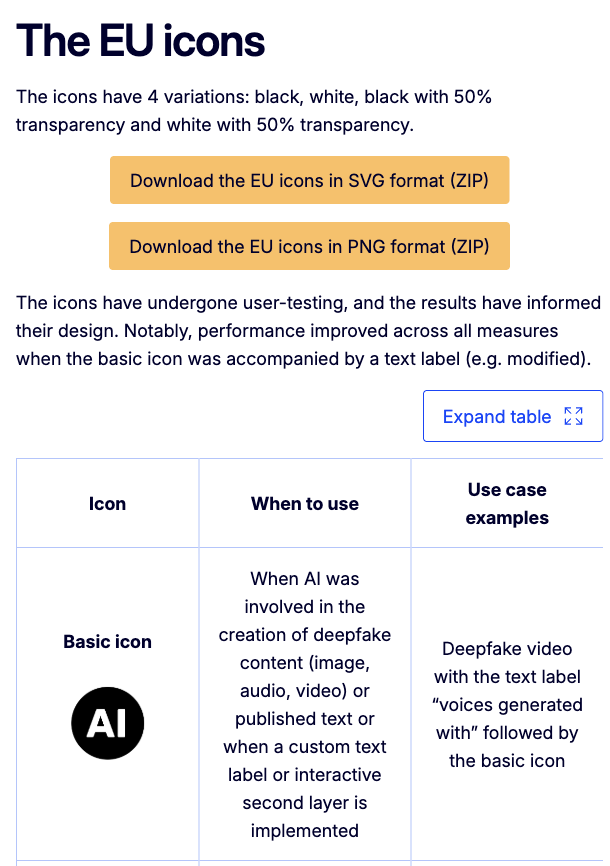
The EU has published a set of icons that deployers may use as labels. Our guide to Article 50 for marketing teams goes through which marketing assets need one, with the Commission's examples.
Who enforces the AI Act and what the fines are
National market surveillance authorities enforce most of the Act, including Article 50. The AI Office enforces it for AI systems built on a general-purpose model by the same provider and for AI in very large online platforms and search engines. The European Data Protection Supervisor covers EU institutions.
The Omnibus makes the AI Office's role specific. Its exclusive competence applies to the providers of those systems, and to their deployers only when they belong to the same company or group. So if a model maker's own chatbot runs on your site, the maker answers to the AI Office for the product, and you answer to your national authority for how you use it.
The fines come from Article 99. Each cap is a fixed amount or a share of total worldwide annual turnover for the preceding financial year, whichever is higher.
- Banned practices
- 35 million EUR
- Article 50 and most other duties
- 15 million EUR
- Wrong or misleading information to authorities
- 7.5 million EUR
AI Act, Article 99
The turnover shares are 7%, 3% and 1% for the same three groups. The middle group covers Article 50, the provider duties in Article 16 and the deployer duties in Article 26. For SMEs each cap is whichever of the two figures is lower. Since the Omnibus the same applies to small mid-caps for the EUR 15 million and EUR 7.5 million caps, but not for banned practices. EU institutions face up to EUR 750,000, or EUR 1.5 million for banned practices (Article 100). Member states set their own penalty rules within these caps and take into account the nature, gravity and duration of a breach.
Which authority you deal with depends on your country. (Update, November 2026: in Poland, the Commission for the Development and Safety of Artificial Intelligence, KRiBSI, held its first meeting on 28 October 2026. It approved online forms for complaints and for requests for individual opinions, to be available from 29 October, and said its first explanations would cover Article 50.) The Omnibus itself names the late set-up of national authorities as one reason for moving the high-risk dates.
What to do before 2 December 2026
These are the steps we would take in a company that uses AI in marketing and may ship AI features. The law does not prescribe this order.
- 01List every AI system you use or offer: chat tools, image and video generators, ad platform features, the chatbot on your site, AI in hiring or credit decisions.
- 02Write your role next to each one: deployer, provider, or both.
- 03Make sure every chatbot, voice agent or avatar that talks to customers says it is AI in its first message.
- 04In your content workflow, mark which outputs could be deepfakes and label them. For text on matters of public interest, name the editor who reviews the substance, or label the text. Google has its own rules for AI content in search, which we cover in our article on Google's AI content guidance.
- 05Ask the vendors of your generative tools whether they signed the Code of Practice, how they mark output and when their tool went on the market.
- 06If you ship a generative feature, check that marking and detection work now for anything launched since 2 August 2026, and by 2 December 2026 for older features.
- 07Check HR and finance tools against Annex III and plan for 2 December 2027.
- 08Write down your AI literacy measures and keep the record current.
What to watch next
Two duties start on 2 December 2026: marking for generative systems already on the market, and the ban on nudification apps. The amended Article 4 asks the Commission to publish practical examples on AI literacy, without a deadline. The Commission says the new high-risk dates are meant to let standards and other support tools arrive before the rules apply.
Article 50 does not wait for any of that. The guidelines and the code are published, and the authorities can act.
Sources
- 01EUR-Lex, Regulation (EU) 2024/1689 laying down harmonised rules on artificial intelligence (AI Act), published in the Official Journal on 12 July 2024
- 02EUR-Lex, Regulation (EU) 2026/1744 (Digital Omnibus on AI), published in the Official Journal on 24 July 2026
- 03European Commission, AI Omnibus enters into force, 27 July 2026
- 04European Commission, Safer and more transparent AI, 2 August 2026
- 05European Commission, Transparency obligations under Article 50 of the AI Act, last updated 24 July 2026
- 06European Commission, Commission publishes guidelines on transparency obligations for providers and deployers of certain AI systems, 20 July 2026
- 07European Commission, Code of Practice on Transparency of AI-generated Content, last updated 31 July 2026
- 08European Commission, AI Act, last updated 3 August 2026
- 09EUR-Lex, Commission Recommendation (EU) 2025/1099 on the definition of small mid-cap enterprises, published in the Official Journal on 28 May 2025
- 10EUR-Lex, Commission guidelines on the implementation of the transparency obligations for certain AI systems under Article 50 of the AI Act, C/2026/6005, published in the Official Journal on 12 November 2026
- 11European Commission, Commission seeks feedback on draft template for the fundamental rights impact assessment under the AI Act, 16 November 2026
- 12KRiBSI, Pierwsze posiedzenie Komisji Rozwoju i Bezpieczeństwa Sztucznej Inteligencji, 28 October 2026
- 13European Commission, EU Icons for labelling AI-generated content, last updated 20 July 2026
- 14European Commission, Guidelines for providers and deployers of AI high-risk systems, last updated 6 July 2026
Frequently asked questions
Did the AI Omnibus delay the AI Act transparency rules?
No. Article 50 applies from 2 August 2026 as planned. The only grace period is for providers of generative AI systems placed on the market before 2 August 2026: they have until 2 December 2026 to mark the output of those systems in a machine-readable way.
We only use AI tools like chatbots and image generators in marketing. What applies to us now?
You are a deployer of those tools. You must label deepfakes you publish and label AI text that informs the public on matters of public interest, unless a person reviewed it and someone holds editorial responsibility. You must also take measures to support the AI literacy of your staff and stay clear of the practices banned since February 2025.
When do the AI Act high-risk rules apply after the AI Omnibus?
From 2 December 2027 for the uses listed in Annex III, such as recruitment, worker management and credit scoring. From 2 August 2028 for AI that is part of products covered by the EU product laws in Annex I, such as toys or lifts.
What is the fine for breaking the AI Act transparency rules?
Up to EUR 15 million or 3% of total worldwide annual turnover for the preceding financial year, whichever is higher. For SMEs and small mid-cap companies the cap is whichever of the two is lower. Banned practices carry up to EUR 35 million or 7%.
Who enforces the AI Act transparency rules?
Mainly the national market surveillance authorities of each EU country. With some exceptions, the AI Office enforces the rules for AI systems built on a general-purpose model by the same provider and for AI in very large online platforms and search engines. The European Data Protection Supervisor covers EU institutions.