
On 1 October 2026 Google added three sentences to its guidance on using generative AI content. They say that generative models predict words instead of retrieving facts, that their output can contain errors, and that every piece of AI-generated content should be fact-checked by hand before publishing, including titles, meta descriptions, structured data and alt text. Google still does not penalize content for being made with AI, and the edit did not change what it treats as spam.
The short version
- 01Google does not penalize content for being made with AI. Its scaled content abuse policy targets many pages made mainly to manipulate rankings with little value for readers, however they were made.
- 02The 1 October change is three sentences, 51 words: a manual fact-check of all AI output, extended to titles, meta descriptions, structured data and alt text.
- 03The references to the Search Quality Rater Guidelines, sections 4.6.5 and 4.6.6, are older. They have been on the page since 21 May 2025.
- 04Raters give the Lowest rating to pages whose main content is almost entirely copied, paraphrased or AI generated with little to no effort, originality and added value. Their ratings do not directly change rankings.
- 05What we would do: one named owner per page, a second person checking every claim against its source, first-hand material a model could not write, and a note on how AI was used where readers would expect one.
- 06In the EU, Article 50 of the AI Act has applied since 2 August 2026. AI-generated text published to inform the public on matters of public interest must be disclosed unless it went through human review or editorial control and someone holds editorial responsibility for it.
What changed on 1 October 2026
Google added three sentences to one section of the page and reworded one phrase. The rest of the text is identical.
We compared the live page, dated 1 October 2026, with the Internet Archive copy of 27 September 2026. The September copy matches, word for word, the first archived copy from 21 May 2025, the day Google added the page. Search Engine Journal compared the new page with the December 2025 version on 1 October and found the same three new sentences.
| Part of the page | Before (27 September 2026 copy) | After (1 October 2026) |
|---|---|---|
| Opening warning on scaled content abuse | Present | Unchanged |
| Pointer to rater guideline sections 4.6.5 and 4.6.6 | Present | Unchanged |
| Models predict likely words and do not retrieve facts | Absent | Added |
| Output may contain inaccuracies (hallucinations) | Absent | Added |
| Fact-check and review all AI content by hand before publishing | Absent | Added |
| Titles, meta descriptions, structured data, alt text | Under the general focus on accuracy | Under the manual review |
| Disclosure section and Merchant Center rules | Present | Unchanged |
The sentence that carries the change reads "It is critical to manually factcheck and review all AI-generated content", and it asks for that review before publishing. The three new sentences come to 51 words.
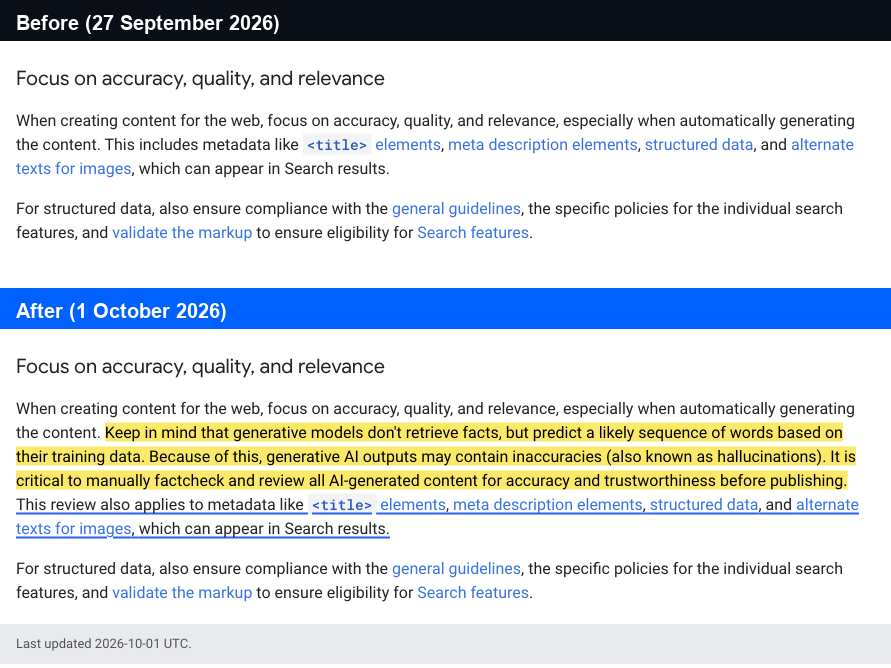
In our reading, the metadata line matters more than it looks. Titles and alt text now fall under the same manual check as the body text, so a title tag written by a model inside a CMS, or alt text generated in bulk, is named as something a person should review.
The page sets no standard for the check. It does not say what counts as a fact-check, who does it, or whether a sample is enough for a large set of pages.
The Search Quality Rater Guidelines link is older than the edit
Google's changelog says the 1 October edit brought in information from the rater guidelines, to match the presentations Google gives at its developer events. The pointer to those guidelines was on the page long before the edit.
The paragraph naming sections 4.6.5 and 4.6.6 is in the 21 May 2025 copy and in the 27 September 2026 copy. None of the new sentences mentions the rater guidelines, and the word hallucination does not appear in the current guidelines, dated 11 September 2025.
The guidelines do cover accuracy. Section 3.2 tells raters to consider how factually accurate an informational page is, and section 5.2 calls mild inaccuracies on informational pages evidence of Low quality. The new sentences fit that, but Google has not said which passage it drew on, and we could not match the wording to one.
Does Google penalize AI content?
No, not for being made with AI. Google's rules judge what a page gives the reader, and the same rules apply to text written by people.
Google's FAQ on AI content, published in February 2023 and still linked from the October page, says that appropriate use of AI or automation is not against its guidelines, and that using AI gives content no special advantage in ranking. The rater guidelines say the same in section 4.6.6: using generative AI tools does not by itself decide the level of effort or the rating a page gets.
What Google acts against is spam. Its spam policies, last updated on 28 August 2026, say a site that violates them may rank lower or not appear in results at all. Google finds violations with automated systems and, where needed, human review that can end in a manual action. If your traffic fell after a spam update, the checks in our guide to the August 2026 spam update help you separate a spam hit from a manual action or a seasonal dip.
The best large dataset we found on ranking points the same way. In a study published in July 2025, Ahrefs took 100,000 random keywords from its keyword tool, collected the top 20 ranking URLs for each, and ran the 600,000 of those pages it held in its database through its own AI content detector:
- Pure human
- 13.5%
- 1 to 10% AI
- 13.8%
- 11 to 40% AI
- 40%
- 41 to 70% AI
- 20.3%
- 71 to 99% AI
- 7.8%
- Pure AI
- 4.6%
Ahrefs, 600,000 pages ranking for 100,000 keywords, July 2025
By that measure, 86.5% of the pages contained some AI-generated text. The correlation between a page's AI share and its ranking position was 0.011, effectively zero. Pages in position one tended to have slightly less AI text, and Ahrefs calls that correlation very weak.
Three limits. Ahrefs sells SEO software, and the detector it used is its own product. A detector estimates, and Ahrefs itself says detectors always carry a risk of false positives. And the sample contains only pages that rank, so it says nothing about pages that were never shown or were removed for spam. Read it as evidence against a blanket penalty on AI text. It does not show that AI text performs well.
AI content the rater guidelines rate as Lowest quality
Raters must give the Lowest rating to scaled content with no added value and to pages whose main content is almost entirely copied, paraphrased or AI generated with little effort, originality and added value, however it was made. Raters do not set rankings: Google says they help evaluate its ranking systems and their ratings do not directly influence ranking. Read the guidelines as a description of what those systems are built to find.
| Section | Rating | When it applies |
|---|---|---|
| 4.6.5 Scaled content abuse | Lowest | Content made at scale with no original content or added value. Raters use Lowest when they strongly suspect it after looking at several pages, even if they cannot tell whether AI was used |
| 4.6.6 Little effort, originality and added value | Lowest | All or almost all of the main content is copied, paraphrased, embedded, auto or AI generated, or reposted with little to no effort, originality and added value, even if the source is credited |
| 5.2.1 Low effort, originality and added value | Low | Much of the main content is repackaged, with little effort to add value by editing, curating or adding original content |
| 5.2.2 Filler | Low | A large amount of low-effort filler, especially ahead of the helpful content |
Section 3.2 defines effort as how much a person actively worked to create satisfying content. Its example of no effort is thousands of pages run through translation software without oversight. We would treat a page built on your own data, with a few paragraphs polished by a model, as a different case from a paraphrase of the top five search results.
Section 4.6.7 tells raters to spot copied text by searching a sentence in quotation marks, and to look for traces an AI tool left behind, such as a chatbot describing itself as a language model. Your editor can do the same.
Google's scaled content abuse policy: when AI content becomes spam
Scaled content abuse is generating many pages mainly to manipulate rankings, with little or no value for users. The policy applies however the pages were made, and what decides it is volume, purpose and added value.
Google introduced the policy on 5 March 2024, building on an older rule against automatically generated content, so that it can act whether pages come from automation, people or both. The examples in the current policy:
- Generating many pages with AI or similar tools without adding value for users
- Scraping feeds, search results or other content to generate many pages, including by synonymizing or translating, with little value added
- Stitching together content from different pages without adding value
- Creating multiple sites to hide the scaled nature of the content
- Creating many pages that make little sense to a reader but contain search keywords
The policy says that if you host such content, you should exclude it from Search. Since 15 May 2026 Google's documentation also states that its spam policies cover generative AI responses in Google Search.
Google gives no number for how many pages make a batch abusive. Our view: one article drafted with AI and then edited, checked and enriched by a person is far from the policy's examples. Hundreds of city or product pages where a model fills a template and nobody adds anything page by page sit close to the first example, and close to Google's doorway abuse policy, which names pages aimed at regions or cities that funnel visitors to one page. The test we would apply before any batch: would each page be worth publishing if search engines did not exist?
How often AI output contains errors
Google gives its reason in the new text: models predict words, so their output can be wrong. One large independent study found a significant issue in 45% of the answers it checked, with sourcing the largest type.
In 2025 journalists from 22 public service media organisations in 18 countries, in a study run by the European Broadcasting Union and the BBC, rated 2,709 answers to news questions from the free versions of ChatGPT, Copilot, Gemini and Perplexity, generated in late May and early June 2025.
- Any significant issue
- 45%
- Sourcing
- 31%
- Accuracy
- 20%
- Missing context
- 14%
- Opinion presented as fact
- 6%
EBU and BBC, News Integrity in AI Assistants, 2,709 answers, May to June 2025
One answer can have several kinds of issue, so the rows overlap. Sourcing problems were the biggest group: claims the cited source did not support, no source at all, or incorrect or unverifiable claims about sources. Significant accuracy problems, including invented details and outdated information, were found in 20% of answers.
This measured assistants answering news questions, a different task from drafting a page with a writing tool. We use it because it is a large, independent test of the same kind of model, and because of the pattern. For a writing team the check is whether the source says what the draft claims. A link on its own proves nothing.
A public failure shows the cost. In May 2025 the Chicago Sun-Times printed a licensed summer section in which 10 of the 15 recommended book titles did not exist. The newsroom then fact-checked the 10 stories in the section that had named sources and found multiple errors and unverifiable information in each. One story quoted the chef Alice Waters, citing a real 2023 magazine interview in which she had said nothing like it. The paper's chief executive later listed five human mistakes behind it, from the freelance writer, who did not check what the AI produced, to the paper's own circulation team, which did not send the pages to editors, and her own approval of the practice.
How to review AI content before publishing: nine steps
This is the process we would run, built on what Google's pages ask for: bylines where readers expect them, a manual fact-check, first-hand material, and metadata in the same review. The second person checking claims against primary sources is our own addition.
- 01Name the owner before anyone writes. One person answers for what the page says, and their name goes on it. Google asks for bylines where readers expect them, and its helpful content guide, updated on 5 October 2026, calls invented authors, such as AI-generated headshots or false credentials, a form of deception.
- 02Collect the first-hand material before the first prompt: what your company knows that a model cannot. The list is below. If it stays empty, ask whether the page should exist.
- 03Draft with AI where it helps. Google's page names research and adding structure to original content as useful uses.
- 04Build a claim sheet. Every number, date, name, quotation and product statement gets one line: the claim, the source URL, the source's publication date, and the passage that supports it.
- 05Have a second person check the sheet against the sources. Anything they cannot confirm comes out.
- 06Review the title, meta description, alt text and structured data in the same pass, and validate the structured data, as Google's page asks.
- 07Search three or four sentences in quotation marks, as raters do, and scan for phrases where the tool talks about itself.
- 08Decide on disclosure, using the next section.
- 09Review batches page by page. The rule we would use: if a batch is too large for a person to read every page, it is too large to publish.
What counts as first-hand material, in our view:
- Your own numbers: prices, timelines and results you are allowed to share.
- What you tested and how: setup, sample, dates, screenshots.
- Decisions and the reasons for them, including the options you rejected.
- Quotations from your own people, or from customers who agreed to be quoted.
- Photos and diagrams you made yourself.
- What went wrong and what you changed.
A model can polish this material. It cannot produce it. Google's guide to generative AI features in Search, updated on 10 July 2026, draws the same line between a first-hand review based on personal experience and a summary of what is already available elsewhere.
Disclosing AI use: Google, Merchant Center and the EU AI Act
Google asks you to consider telling readers how content was made where they would expect to know. The only firm labelling rules on its AI content page are the Merchant Center ones. EU law has added duties for some content since 2 August 2026, when the AI Act's transparency rules started to apply.
On Google's side: the AI content page suggests that if you generate content automatically, you explain how automation was used and add image metadata. Where automation substantially generated the content, the helpful content guide asks whether its use is clear to visitors, how it was used and why it was useful. The 2023 FAQ says an AI author byline is probably not the best way to be open about it. Merchant Center requires AI-generated product images to carry IPTC metadata (DigitalSourceType TrainedAlgorithmicMedia) and AI-generated product titles and descriptions to be labelled.
On the EU side, the European Commission confirmed that the AI Act's transparency rules apply from 2 August 2026. Article 50(4) requires deployers of an AI system that generates or manipulates text published to inform the public on matters of public interest to disclose that the text was artificially generated or manipulated. The duty does not apply where the text went through human review or editorial control and a person or company holds editorial responsibility for it. (Update, November 2026: the Commission's guidelines on Article 50, which include a section on this exception, were published in the Official Journal on 12 November 2026 as C/2026/6005. They are non-binding, and our guide to Article 50 for marketing teams covers which labels apply.) The same paragraph requires disclosure of deep fakes, which Article 3(60) defines as AI-generated or manipulated image, audio or video content that resembles real people, objects, places or events and would falsely appear authentic. Machine-readable marking, in Article 50(2), is a duty of the AI tool providers. The Digital Omnibus on AI, an amendment published in the Official Journal on 24 July 2026, gives providers whose systems were on the market before 2 August 2026 four months, to 2 December 2026, to apply that marking, and it left the wording of Article 50(4) unchanged. This is our summary of the text, not legal advice.
| What you publish | EU AI Act, Article 50 | What we would do | |
|---|---|---|---|
| Article drafted with AI, edited and fact-checked under a named editor | Disclosure where readers would ask how it was made | For public interest text, the human review exception can apply | A one-line note on how AI was used and who checked the facts |
| Pages generated automatically with little human work per page | Explain how automation was used | For public interest text, disclosure is required | Avoid; if published, label every page |
| Photorealistic AI image of a real person, place or event | Add image metadata | If it would falsely appear authentic, it is a deep fake: disclose it | Label it in the caption and keep the metadata |
What we would not do
- Run drafts through an AI detector to predict how Google will treat them. None of the Google documents cited here mentions a detector score, and in the Ahrefs data pages rated pure AI by a detector still ranked in the top 20.
- Treat the rater guidelines as a ranking checklist. Google's page says they are not a guide to ranking first.
What to change after the update
After more than 16 months with the same text, the page gained a process step. The policy behind it dates from March 2024. If your team already checks facts and adds its own material, the new work is small: put titles, meta descriptions, structured data and alt text through the same review as the body, and record who did the check.
Sources
- 01Google Search Central, Google Search's guidance on using generative AI content on your website, last updated 1 October 2026
- 02Google Search Central, the same page, Internet Archive copy, page version of 10 December 2025, archived copy of 27 September 2026
- 03Google Search Central, the same page, first Internet Archive copy, archived copy of 21 May 2025
- 04Google Search Central, Latest Google Search documentation updates, entries of 21 May 2025, 15 May 2026 and 1 October 2026
- 05Google, Search Quality Rater Guidelines (General Guidelines), 11 September 2025
- 06Google Search Central, Spam policies for Google web search, last updated 28 August 2026
- 07Google Search Central Blog, What web creators should know about our March 2024 core update and new spam policies, 5 March 2024
- 08Google Search Central Blog, Google Search's guidance about AI-generated content, 8 February 2023
- 09Google Search Central, Creating helpful, reliable, people-first content, last updated 5 October 2026
- 10Google Search Central, Optimizing your website for generative AI features on Google Search, last updated 10 July 2026
- 11Search Engine Journal, Google Tells Sites To Fact-Check AI Content Before Publishing, 1 October 2026
- 12Ahrefs, AI-Generated Content Does Not Hurt Your Google Rankings (600,000 Pages Analyzed), 7 July 2025
- 13EBU and BBC, News Integrity in AI Assistants, October 2025
- 14Chicago Sun-Times, Special section with fake book list plagued with additional errors, Sun-Times review finds, 29 May 2025
- 15Chicago Sun-Times, Lessons (and an apology) from the Sun-Times CEO on that AI-generated book list, 29 May 2025
- 16European Union, Regulation (EU) 2024/1689 (Artificial Intelligence Act), Official Journal, 12 July 2024
- 17European Commission, Commission starts enforcing AI Act rules and new transparency requirements on 2 August, 31 July 2026
- 18European Union, Regulation (EU) 2026/1744 (Digital Omnibus on AI), Official Journal, 24 July 2026
- 19European Commission, Guidelines on the implementation of the transparency obligations for certain AI systems under Article 50 of Regulation (EU) 2024/1689 (C/2026/6005), Official Journal, 12 November 2026
Frequently asked questions
Can AI-written content rank on Google?
Yes. Google does not penalize content for being made with AI: its spam policies target many pages generated mainly to manipulate rankings with little or no value for users, however they were made. In a 2025 study by Ahrefs, which sells SEO software, of 600,000 top-20 pages scored with its own AI detector, the correlation between a page's estimated AI share and its ranking position was 0.011, effectively zero.
What did Google change in its AI content guidance on 1 October 2026?
Google added three sentences to its page on using generative AI content. They say that models predict words instead of retrieving facts, that the output can contain errors, and that all AI-generated content should be fact-checked by hand before publishing. The same review now explicitly covers titles, meta descriptions, structured data and image alt text.
Do I have to label AI-generated content for Google?
Google does not require a label on articles. It suggests telling readers how content was made where they would reasonably expect to know, and says an AI author byline is probably not the best way to do that. Merchant Center is stricter: AI-generated product images need IPTC metadata, and AI-generated product titles and descriptions must be labelled.
Do the Search Quality Rater Guidelines affect my rankings?
Not directly. Google says raters help it evaluate its ranking systems and that their ratings do not directly influence ranking. The guidelines still show what those systems are meant to find, including the Lowest rating for scaled content and for pages made with little to no effort, originality and added value.
Does the EU AI Act require me to disclose AI-written blog posts?
Article 50(4) applies from 2 August 2026 to AI-generated text published to inform the public on matters of public interest. It does not apply where the text went through human review or editorial control and a person or company holds editorial responsibility for it. AI-generated deep fake images, audio and video must be disclosed. This is a summary of the text, not legal advice.