
Since 2 August 2026, Article 50 of the EU AI Act has required a clear label on deepfakes, such as an AI video of a celebrity in an ad or an AI product shot that makes the product look better than it is. AI text published to inform the public on matters of public interest needs a label too, unless a person reviewed it and took editorial responsibility. Chatbots must tell people they are AI. In the Commission's examples, AI ad copy and product descriptions stay outside the text rule as long as they make no claims on matters such as health, consumer safety or sustainability.
The 2026 amendment to the Act left that start date in place. We checked every date and EU rule against the primary texts on 21 November 2026. This guide takes each rule from the law, the Commission's Article 50 guidelines and the code of practice, with the Commission's own marketing examples, down to talking mice in a cheese ad. It is not legal advice, and where the texts are unclear, we say so.
The short version
- 01Article 50 has applied since 2 August 2026. The Digital Omnibus on AI did not move it; only makers of generative AI tools already on the market got until 2 December 2026 for machine-readable marks.
- 02When your team uses AI at work, you are a deployer. You owe labels on deepfakes and on AI text published to inform the public on matters of public interest.
- 03Human review with named editorial responsibility can replace the text label, never a deepfake label.
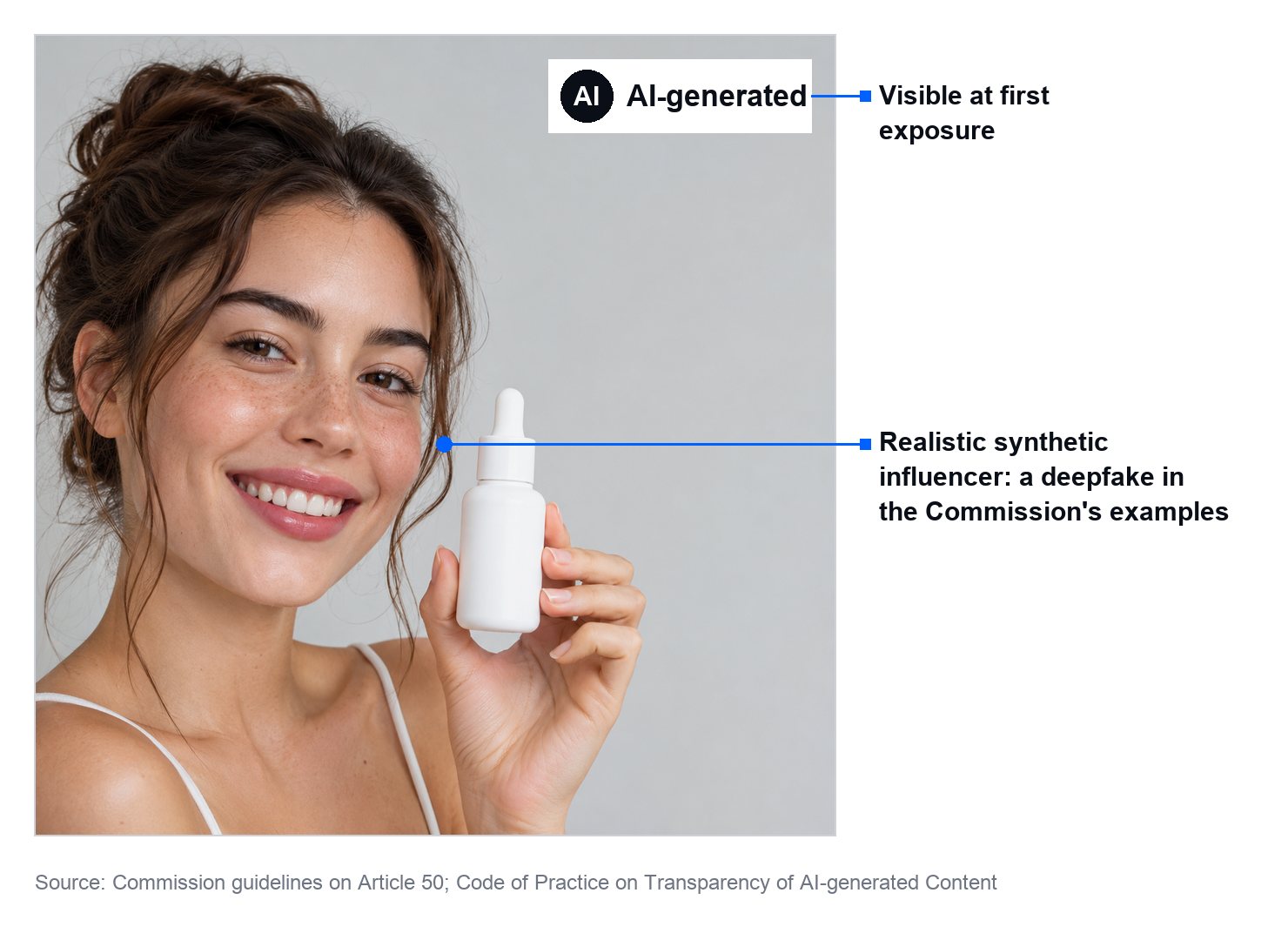
- 04Ad copy and product descriptions are outside the text rule, as long as they make no claims on matters such as health, consumer safety or sustainability. A celebrity likeness, a realistic synthetic influencer or an AI product image that misrepresents the product is a deepfake in the Commission's examples.
- 05The chatbot disclosure is a duty of whoever built the bot. If your team built it, that is you.
- 06A label must be visible or audible at first exposure. A hidden watermark does not count.
- 07Fines reach EUR 15 million or 3% of worldwide turnover, whichever is higher; for SMEs and small mid-caps, whichever is lower.
When Article 50 applies, and what the Digital Omnibus changed
Article 50 has applied since 2 August 2026. The Digital Omnibus on AI gave it one delay, for machine-readable marks on generative tools already on the market. The dates, from the official texts and announcements:
| Date | What happened |
|---|---|
| 10 June 2026 | Final Code of Practice on Transparency of AI-generated Content published |
| 8 to 9 July 2026 | The Commission, then the AI Board, find the code adequate |
| 20 July 2026 | Commission publishes its Article 50 guidelines |
| 27 July 2026 | Digital Omnibus on AI, Regulation (EU) 2026/1744, enters into force |
| 31 July 2026 | First list of code signatories, more than 180 organisations |
| 2 August 2026 | Article 50 starts to apply |
| 12 November 2026 | Guidelines published in the Official Journal as C/2026/6005 |
| 2 December 2026 | Marking deadline for generative tools on the market before 2 August |
The omnibus delayed the high-risk rules; our AI Act timeline of what applies since August 2026 and what the omnibus postponed has those dates. For Article 50, the change that matters is a new Article 111(4): providers of generative systems placed on the market before 2 August 2026 must meet the marking duty in Article 50(2) by 2 December 2026. The guidelines confirm this grace period covers marking only.
Deepfakes made before 2 August, and AI text published before it, need no retroactive label. Text generated earlier but published on or after 2 August does.
Provider or deployer: who owes which Article 50 duty
The company that builds an AI tool owes the chatbot disclosure and the machine-readable marks; the company that uses it at work owes the visible labels. Article 3(3) defines the provider as whoever develops an AI system and puts it out under its own name; Article 3(4) defines the deployer as whoever uses one under its authority, outside personal non-professional use.
| Duty | Who owes it | Article | Main exceptions |
|---|---|---|---|
| Tell people they are talking to AI | Provider | 50(1) | Obvious from context; authorised crime-fighting use |
| Mark outputs in a machine-readable way | Provider | 50(2) | Standard editing; no substantial change to the input |
| Label deepfakes | Deployer | 50(4) | Lighter label for evidently artistic, creative, satirical or fictional work |
| Label AI text on matters of public interest | Deployer | 50(4) | Human review plus editorial responsibility |
| Clear, accessible, at first exposure | Both | 50(5) | None |
The guidelines settle some marketing cases:
- The company is the deployer, including when its employees run the tool, or freelancers run it on its behalf and under its control.
- When a brand only commissions an agency and does not decide whether and how the agency uses AI, the agency is the deployer, not the brand.
- A person who earns from the activity on a regular basis acts professionally, so a paid creator using AI is a deployer.
If you pay creators, our guide to UGC and creator content in Europe covers how to contract them and what paid posts must disclose.
Chatbots and voice agents: when a bot must say it is AI
A chatbot or voice agent that talks to the public must say it is AI, at the latest at the first interaction. Article 50(1) puts that duty on the provider, so start by asking who built it.
The guidelines name an organisation that develops a chatbot in house and runs it under its own name as the provider. If you bought a finished product, the vendor is. If you modify an existing system, for example with new training data, and run it under your own name, you become the provider of the new system. Whether connecting a vendor's bot to your own documents counts, the guidelines do not say. We would treat any bot on your site as yours to check, because it carries your brand.
The guidelines accept a first message saying the assistant is AI, a plain label such as "You are interacting with an AI system" near the input field, a spoken statement at the start of a voice session, and an honest answer whenever someone asks. They do not accept, on its own, a line in the terms, an invisible watermark, a vague name such as assistant, a human-looking avatar, a sitewide note that services use AI, or a tone without words.
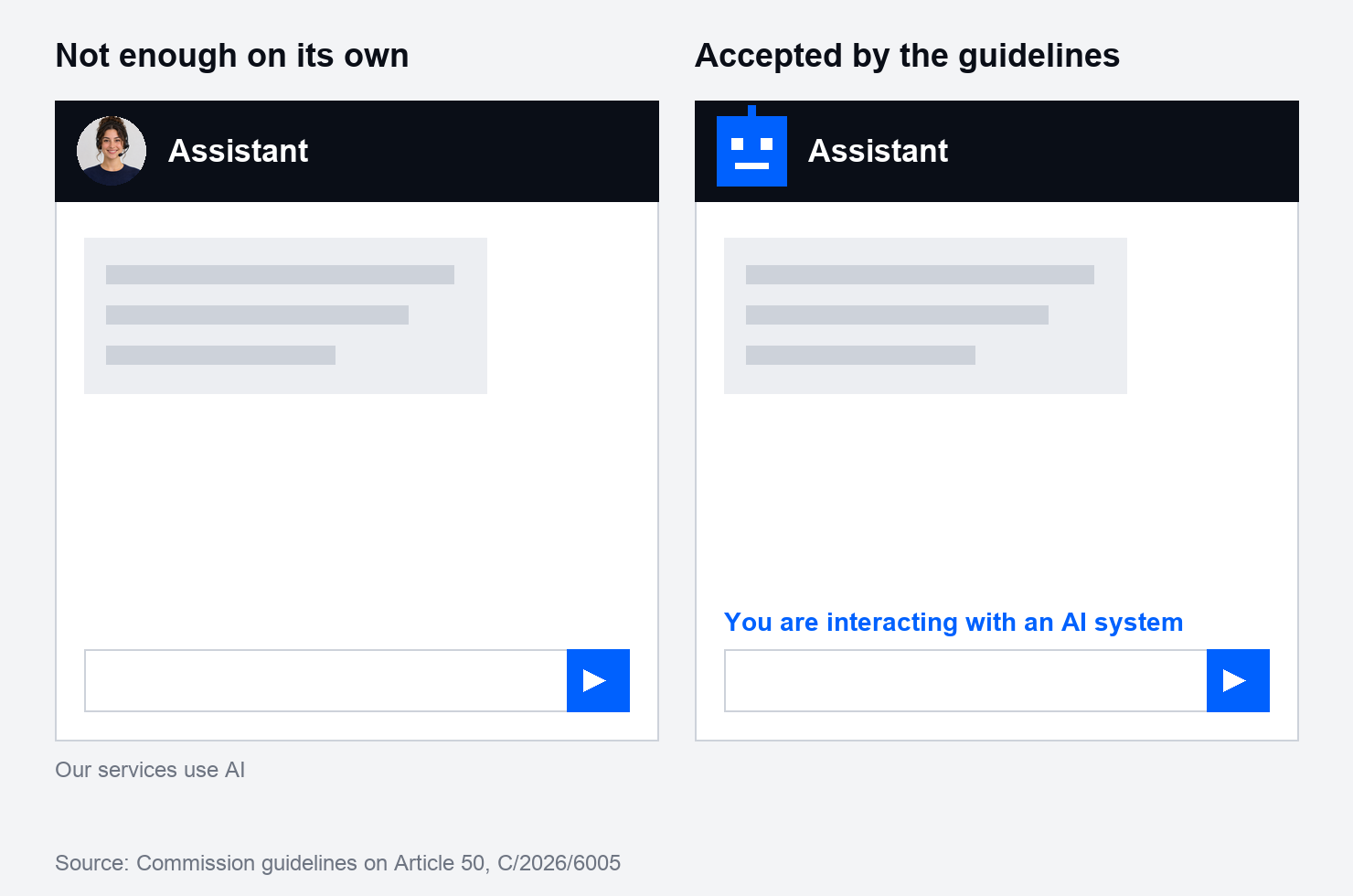
The exception for obvious cases is narrow. The guidelines say it "should be limited to cases where there is almost no doubt left", and use helpdesk chatbots that users may take for humans as an example where disclosure applies. For financial advice, insurance, health and complaints they expect reminders during the conversation.
A human agent who drafts replies with AI is outside the rule. An AI agent that emails people is inside it, and the guidelines suggest an AI label at the top of the email.
AI images and video in ads: the deepfake test
An AI image or video needs a label when it is a deepfake, which the Act itself writes as "deep fake": Article 3(60) covers AI-generated or manipulated image, audio or video that resembles existing persons, objects, places, entities or events and would falsely appear authentic or truthful.
The guidelines read this broadly. A subject that could plausibly exist is enough, realistic AI personas count as persons, and intent is irrelevant. The Commission's own advertising examples:
| Example from the guidelines | Deepfake? |
|---|---|
| AI video of a celebrity influencer in an ad | Yes |
| Realistic synthetic avatar of the company's CEO congratulating staff | Yes |
| AI product image that makes the product look different or better than it is | Yes |
| Teleshopping-style video with simulated consumers using a product | Yes, full label |
| Realistic synthetic influencer testing a sponsored real product | Yes, full label |
| Real car against an AI-generated background, without misleading about the car | No |
| AI mice arguing over cheese in a cheese ad | No |
| AI colour correction, background extension or rescaling in a product ad | Likely not, minor impact |
The lighter regime for evidently artistic, creative, satirical or fictional work fits an ad only sometimes: content that is exclusively commercial and recognisable as such is excluded, and where creative and informative character mix, the informative side prevails. Even the lighter regime requires a label, placed so it does not spoil the work.
AI voices: when a cloned or synthetic voice needs a label
A cloned voice of a real person is a deepfake; a voice for an obviously fictional character is not. The guidelines give AI cloning of a podcast's regular presenters as a deepfake, and voices for fictional characters in audiobooks, games or animation as out of scope when nobody is misled about who is speaking.
The realistic synthetic narrator in a radio spot sits between those. Voice is among the personal characteristics the guidelines list, so our reading is that a human-sounding AI voice that listeners would take for a real speaker needs a label. No example in the guidelines settles it.
For audio, the code asks for a short spoken disclaimer at the start, in the content's language or English, plus a visual icon when a screen is present.
AI-written text: what needs a label and when review replaces it
AI text needs a label only when it is published to inform the public on a matter of public interest, and then only if nobody reviewed it and took editorial responsibility. Ad copy and product descriptions are outside in the Commission's examples; some content marketing can be inside.
Examples in the guidelines that need a label unless reviewed: an AI summary of an article on a town council decision, AI-altered parts of a lifestyle article comparing diets for a disease, AI-altered investor information in a listed company's reports. Outside the rule: AI ad copy and product descriptions without claims on matters such as health, consumer safety or sustainability, a chatbot summary seen only by the person who asked, and internal communications, which are not published.
Public interest is broad: politics, public health, environmental protection, consumer safety and any economic, financial, scientific or cultural development that may be a subject of public debate. In our reading, a B2B article on new regulation could fall inside; a post on spreadsheet formatting probably does not. The line is no more precise than that.
The review exception has two conditions:
- 01A person with relevant knowledge examines the substance, with fact-checking as the minimum. Spell-checks, automated review and cursory approval do not count, and substantive AI changes after sign-off void the exception.
- 02A natural or legal person holds editorial responsibility, with identity and contact details published where readers can find them. The code adds a policy that names that person and describes the review steps.
The guidelines list a human-reviewed AI translation of an article as meeting the exception, and count AI translation as standard editing for the marking duty. Our reading: an unreviewed machine translation of a public interest article would still need a label, though the texts do not settle it.
Google's rules for AI content in search are a separate matter from the AI Act; we cover them in our article on Google's AI-generated content guidance.
AI editing vs AI generation: where the line sits
Light technical edits do not trigger a duty; edits that change meaning do. The guidelines draw this line for the marking duty in Article 50(2), and the deepfake test treats insignificant edits the same way.
| Change | Treatment in the guidelines |
|---|---|
| Grammar and spelling fixes, minor stylistic polish | Standard editing |
| Minor crop, colour or contrast fixes, noise removal | Standard editing |
| AI summary, or a rewrite that changes style, structure or meaning | Must be marked |
| Inserting or removing objects or people in a way that changes meaning | Must be marked |
| Face swap, cloned speech, video of events that never happened | Must be marked, may also be a deepfake |
Marking is the tool maker's job; your label depends on the deepfake test or the text rule.
Article 50 fines and who enforces them
An Article 50 breach can cost up to EUR 15 million or 3% of total worldwide annual turnover, whichever is higher, under Article 99(4). For SMEs, Article 99(6) makes it whichever is lower, and the omnibus extended that to small mid-caps in Article 99(6a).
- Prohibited practices, Article 5
- 35 EUR million
- Transparency, Article 50
- 15 EUR million
- Incorrect information to authorities
- 7.5 EUR million
Regulation (EU) 2024/1689, Article 99(3) to (5)
A small mid-cap is a non-SME with fewer than 750 staff and turnover up to EUR 150 million or a balance sheet up to EUR 129 million. Our calculation, assuming each company meets its size definition: an SME with EUR 40 million turnover has a cap of EUR 1.2 million, since 3% is lower than EUR 15 million. A small mid-cap with EUR 120 million turnover: EUR 3.6 million. A large company with EUR 300 million turnover: 3% is EUR 9 million, so EUR 15 million applies. At EUR 2 billion turnover, 3% is EUR 60 million.
- SME, EUR 40m turnover
- 1.2 EUR million
- Small mid-cap, EUR 120m turnover
- 3.6 EUR million
- Large company, EUR 300m turnover
- 15 EUR million
- Large company, EUR 2bn turnover
- 60 EUR million
Our calculation from AI Act Article 99(4), (6) and (6a)
These are ceilings. Authorities weigh gravity, duration, intent and cooperation, and code commitments can mitigate a fine. Member States set the penalty rules; we did not check each country's.
National market surveillance authorities enforce, and anyone with grounds to suspect a breach can complain to them. In Poland, the regulator KRiBSI held its first meeting on 28 October 2026 and said its first explanations would cover Article 50. For code signatories, supervision checks adherence to the code; non-signatories should expect more information requests.
A label does not make an unlawful ad lawful. Misleading advertising rules, data protection, personality rights and copyright still apply.
An Article 50 labelling checklist for marketing teams
The steps we would take, built on the guidelines and Section 2 of the code:
- 01List every AI use in marketing: bots, voice, image, video, writing and translation tools, and who built each.
- 02Bots you built: a first-message disclosure, a label by the input field, an honest answer when asked, reminders in sensitive flows. Bots you bought: check that the vendor's disclosure is on.
- 03Run each visual and audio asset through the deepfake test: does it resemble a real or plausible person, product, place or event, and would your audience take it as real? For product shots, ask whether AI changed how the product looks or works.
- 04Label deepfakes where people see them: an "AI" icon plus words such as "AI-generated", top right on images and video, at the start of a video and after breaks, spoken at the start of audio, embedded so it survives a repost. In the Commission's user testing, the icon did better on every measure with a text label beside it.
- 05For public interest text, label it near the headline or run a real review: a named reviewer with subject knowledge, a fact-check, sign-off after the last AI edit, and the responsible person's name and contact published.
- 06Write it into contracts with agencies, freelancers and creators: who decides on AI use, and that labels stay on in distribution.
- 07Keep a short record of how you label, who was trained, and an address for reporting a missing label.
- 08Decide whether to sign Section 2 of the code. We think it pays if you publish deepfakes regularly, because supervision then checks a known list of measures.
If you worry that labels cost engagement, one controlled study, published at CHI in April 2025, showed social posts with or without AI labels to 911 people recruited online in August 2024. Labels raised belief that the images were AI-made and did not significantly change how likely people said they were to like, comment or share. It measured stated intent in a mock feed.
What the Article 50 guidelines leave unclear
The guidelines are non-binding; only the Court of Justice interprets the Act with authority. Open points:
- Whether branding and configuring a vendor's chatbot makes you its provider.
- Where public interest starts for B2B content.
- Realistic synthetic voices and AI people who resemble no one in particular.
- Whether light AI editing of human text falls outside Article 50(4); the guidelines spell out standard editing only for marking.
- How national authorities will set fines.
Until the Commission revises the guidelines, we would label in the grey zone. A small "AI" mark costs little, and the deepfake definition turns on what your audience would believe.
Sources
- 01EUR-Lex, Regulation (EU) 2024/1689 (Artificial Intelligence Act), published in the Official Journal on 12 July 2024
- 02EUR-Lex, Regulation (EU) 2026/1744 (Digital Omnibus on AI), published in the Official Journal on 24 July 2026
- 03European Commission, AI Omnibus enters into force, 27 July 2026
- 04European Commission, Guidelines on the implementation of the transparency obligations for certain AI systems under Article 50 of the AI Act, C/2026/6005, published in the Official Journal on 12 November 2026
- 05European Commission, Commission publishes guidelines on transparency obligations for providers and deployers of certain AI systems, 20 July 2026
- 06European Commission, Code of Practice on Transparency of AI-Generated Content (PDF), 10 June 2026
- 07European Commission, Commission opinion on the assessment of the Code of Practice on Transparency of AI-generated Content, 9 July 2026
- 08European Commission, Commission starts enforcing AI Act rules and new transparency requirements on 2 August, 31 July 2026
- 09European Commission, EU Icons for labelling AI-generated content, last updated 13 October 2026
- 10European Commission, Transparency obligations under Article 50 of the AI Act, FAQ, last updated 24 July 2026
- 11EUR-Lex, Commission Recommendation (EU) 2025/1099 on the definition of small mid-cap enterprises, published in the Official Journal on 28 May 2025
- 12KRiBSI, Pierwsze posiedzenie Komisji Rozwoju i Bezpieczeństwa Sztucznej Inteligencji, 28 October 2026
- 13Gamage, Sewwandi, Zhang and Bandara, Labeling Synthetic Content: User Perceptions of Label Designs for AI-Generated Content on Social Media, CHI 2025, 25 April 2025
Frequently asked questions
Do I have to label AI-generated ad copy in the EU?
Not under the AI Act's text rule, in the Commission's reading. Its Article 50 guidelines list AI-written advertising and product descriptions as outside the text labelling rule, as long as they make no claims on matters such as health, consumer safety or sustainability. EU rules against misleading advertising still apply to the copy itself.
Does the chatbot on my website have to say it is an AI?
Yes, unless that is obvious to a reasonably well-informed user, and the Commission reads that exception narrowly. The legal duty sits with the provider, the company that built the bot and runs it under its own name, which is you if you built it. The disclosure must be clear at the first interaction at the latest; a line in the terms and conditions is not enough.
Is an AI-generated image in an ad a deepfake?
It is when it resembles real or plausible people, objects, places or events and would falsely appear authentic to the audience. The Commission's examples of deepfakes include an AI video of a celebrity influencer in an ad and a product image that makes the product look better than it is. A real product on an AI background that does not mislead, or a plainly fantastical scene, are given as examples that are not.
Can human review replace the AI label on an article?
For text on matters of public interest, yes, if a person with relevant knowledge checks the substance, including the facts, and a named person or company holds editorial responsibility. Spell-checking or a quick approval does not count, and substantive AI edits made after sign-off cancel the exception. Human review never removes the label on a deepfake.
What are the fines for breaking Article 50?
Up to EUR 15 million or 3% of total worldwide annual turnover, whichever is higher. For SMEs and small mid-cap companies the cap is whichever of the two is lower. National market surveillance authorities enforce the rules and decide fines case by case.